Margin Terms Explained
What your broker's account numbers mean, worked through one $150,000 trade in a $100,000 account
Your broker reports a lot of numbers that look alike: net liquidation, equity with loan, available funds, excess liquidity, buying power. Each one answers a different question, and two of them decide what happens to your trades:
- Available Funds decides whether a new order is accepted.
- Excess Liquidity decides whether the broker starts closing your positions.
This guide explains each number in plain language and then works through one trade in three kinds of account: a standard margin account (Reg T), a portfolio margin account and a cash account.
It uses the names Interactive Brokers (IB) shows in the TWS Account window. Other brokers report the same ideas under different labels.
The example
- The account: $100,000 in cash and no positions.
- The trade: buy 3,000 shares of a made-up stock, XYZ, at $50. That is a $150,000 position, bigger than the account.
The trade only works because the broker lends the other $50,000. How much it lends, and when it takes the shares back, is what margin is about.
How the numbers fit together
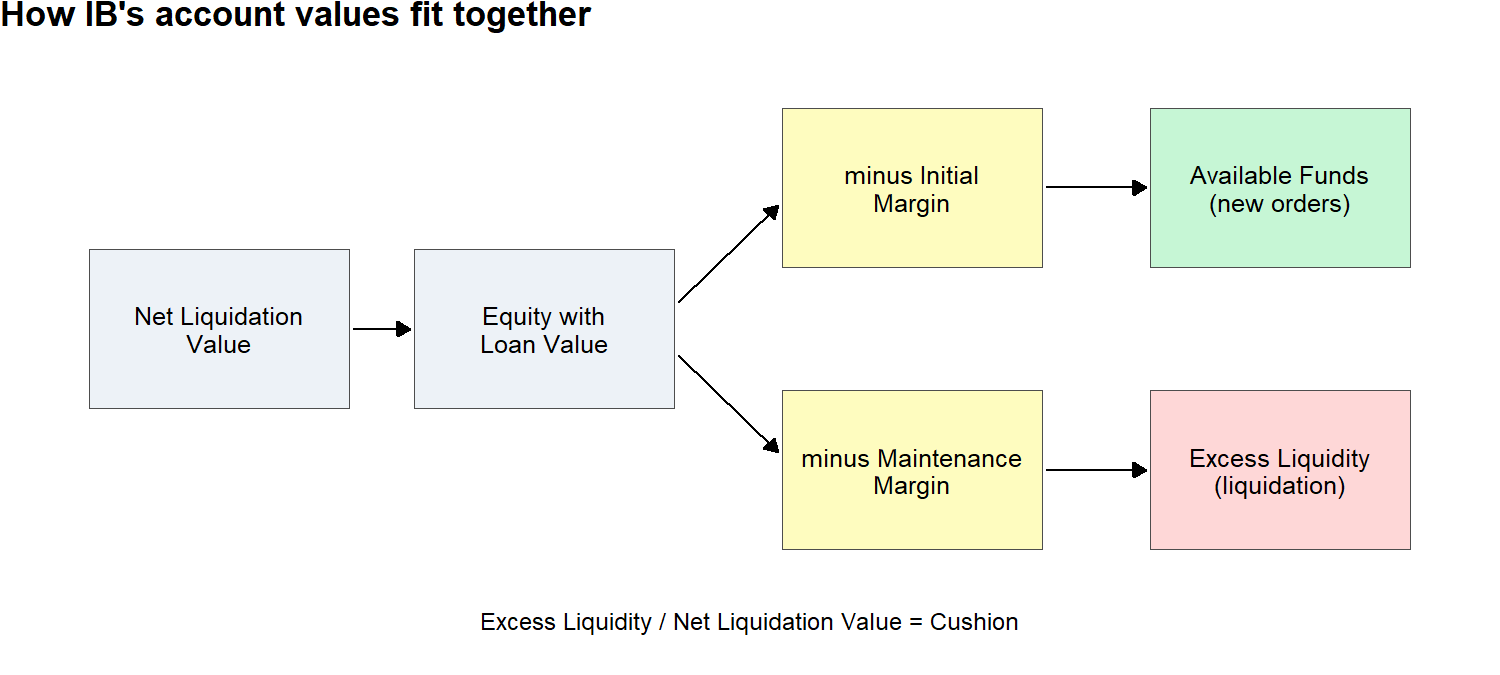
Start from what the account is worth. Subtract what the broker needs to open new positions, and you get what is left for new orders. Subtract what the broker needs to keep the positions you have, and you get how far you are from a forced sale.
The terms
Notional
The dollar size of a position: shares x price. 3,000 shares of XYZ at $50 is $150,000 notional.
Notional is not what the trade costs you. It is how big the position is. The cost to you is the margin requirement, explained below.
Net Liquidation Value
What the account would be worth if you closed everything at current prices: cash, plus the value of your long positions, minus what it would cost to buy back any shorts.
Buying $150,000 of XYZ with $50,000 of borrowed money does not change net liquidation. You now hold $150,000 of stock and owe $50,000, so the account is still worth $100,000. It changes only when XYZ's price moves.
At zero: the account is worth nothing. In a margin account it can even go below zero, and then you owe the broker money.
Equity With Loan Value
The collateral the broker measures your margin against. For an account that holds only stocks it is the same as net liquidation. They differ for things like options, which is outside this guide.
Equity With Loan Value = cash + value of stocks (for a stock-only account)
Gross Position Value
The total size of all your positions, ignoring direction: longs plus the absolute value of shorts. A $150,000 long and a $50,000 short add up to $200,000 gross. It measures how much exposure you carry, not how much the account is worth.
Leverage
How many dollars of stock you hold for each dollar of equity.
Leverage = Gross Position Value / Net Liquidation Value
After the XYZ trade, leverage is $150,000 / $100,000 = 1.5.
Initial margin and maintenance margin
The margin requirement is the part of a position you must cover with your own money. The broker lends the rest. If a stock's requirement is 25%, a $150,000 position needs $37,500 of your equity.
There are two levels:
- Initial Margin is what you need to open a position. It is checked when you send an order.
- Maintenance Margin is what you need to keep a position. It is the same as or lower than initial.
The rate is set per stock, and it can change. See "Why the margin rate differs from stock to stock" below.
Available Funds
What is left for opening new positions.
Available Funds = Equity With Loan Value - Initial Margin
When an order would push Available Funds below zero, IB rejects it. The message reads: "Your Available Funds are insufficient to cover the change in the account's margin requirements." Nothing is sold. The new order just doesn't go through.
Excess Liquidity
How much room is left before the broker starts selling.
Excess Liquidity = Equity With Loan Value - Maintenance Margin
When Excess Liquidity goes below zero, IB starts closing positions on its own. There is no margin call first, and you don't get to choose which positions are sold. IB sells enough, at market, to bring Excess Liquidity back above zero.
Cushion
Excess Liquidity as a share of the account.
Cushion = Excess Liquidity / Net Liquidation Value
A cushion of 10% means you are 10% of the account's value away from liquidation. IB sends a warning when the cushion falls to 10%.
Buying Power
How much more stock you could buy right now. IB works it out from Available Funds:
- Margin account:
Buying Power = (lower of today's and yesterday's Equity With Loan Value - Initial Margin) x 4 - Cash account:
Buying Power = lower of today's and yesterday's Equity With Loan Value - Initial Margin
The 4 comes from the 25% intraday requirement on a typical stock: $1 of available funds supports $4 of stock. That makes Buying Power an estimate. A stock that IB charges 50% for uses up twice as much of it.
Intraday vs overnight buying power. IB's Buying Power is an intraday number. Overnight, a Reg T account needs 50% for each stock, so what you can still hold overnight is about half as much. In a Reg T account that is the SMA (see below) times 2.
The pattern day trader rule is gone. Until June 2026, FINRA's pattern day trader rule required $25,000 in an account that day trades on margin, and set its "day trading buying power." FINRA replaced it with intraday margin standards that took effect on June 4, 2026. Brokers have until October 20, 2027 to switch over. At IB:
- The $25,000 minimum is removed. The $2,000 minimum for trading on margin or shorting still applies.
- A trade that reduces Excess Liquidity can create an Intraday Margin Deficit. IB asks you to cover it as promptly as possible, ideally within 3 business days.
- Failing to cover one 4 or more times in 12 months can bring a 90-day trading restriction on all your margin accounts.
- Until the transition period ends, your account may still be under the old pattern day trader rules.
SMA (Special Memorandum Account)
A Reg T bookkeeping number: a line of credit that builds up as your account gains value. Buying stock uses it up at 50% of the purchase, and withdrawing cash uses it dollar for dollar. Unlike Available Funds, it doesn't fall when your stocks fall.
IB checks it once a day. If SMA is negative between 15:50 and 17:20 ET, the account has a Reg T violation and IB liquidates positions. This is how the 50% overnight requirement is enforced.
Intraday vs overnight margin
IB lets a Reg T account carry more during the day than overnight. During the day a typical stock needs 25%. For positions still open at the close, Reg T requires 50%.
So near the close, the requirement for anything you are holding steps up. A position that fit comfortably at 11:00 can be too big at 15:50.
Portfolio margin accounts don't have this step: FINRA requires their intraday margin to be substantially the same as overnight.
Look Ahead values
IB's projection of each value at the next margin change. Near the close, that is the overnight requirement.
- Look Ahead Initial Margin and Look Ahead Maintenance Margin: the requirements at the next change.
- Look Ahead Available Funds:
Equity With Loan Value - Look Ahead Initial Margin. - Look Ahead Excess Liquidity:
Equity With Loan Value - Look Ahead Maintenance Margin. - Look Ahead Next Change: when the next change takes effect.
If a Look Ahead value is negative, you will have a problem when the change takes effect. You can see it hours ahead.
Settlement and settled cash
When you buy or sell US stock, the cash and shares change hands one business day later. This is called T+1, and it has been the rule since May 28, 2024. A sale on Monday gives you settled cash on Tuesday.
In a margin account this barely matters, since the broker covers the gap. In a cash account it decides what you can do. See the cash account scenario.
Scenario 1: Reg T margin account
A standard margin account at IB. For a typical long stock:
- Intraday: 25% initial and 25% maintenance.
- Overnight: 50% initial (Reg T), checked through the SMA at 15:50 ET. Maintenance stays at 25%.
Buying 3,000 XYZ at $50
| Value | Before the trade | After the trade (intraday) | Look Ahead (overnight) |
|---|---|---|---|
| Cash | $100,000 | -$50,000 | -$50,000 |
| Gross Position Value | $0 | $150,000 | $150,000 |
| Net Liquidation Value | $100,000 | $100,000 | $100,000 |
| Equity With Loan Value | $100,000 | $100,000 | $100,000 |
| Leverage | 0 | 1.5 | 1.5 |
| Initial Margin | $0 | $37,500 (25%) | $75,000 (50%) |
| Maintenance Margin | $0 | $37,500 (25%) | $37,500 (25%) |
| Available Funds | $100,000 | $62,500 | $25,000 |
| Excess Liquidity | $100,000 | $62,500 | $62,500 |
| Cushion | 100% | 62.5% | 62.5% |
| SMA | $100,000 | $25,000 | $25,000 |
| Buying Power | $400,000 | $250,000 | n/a |
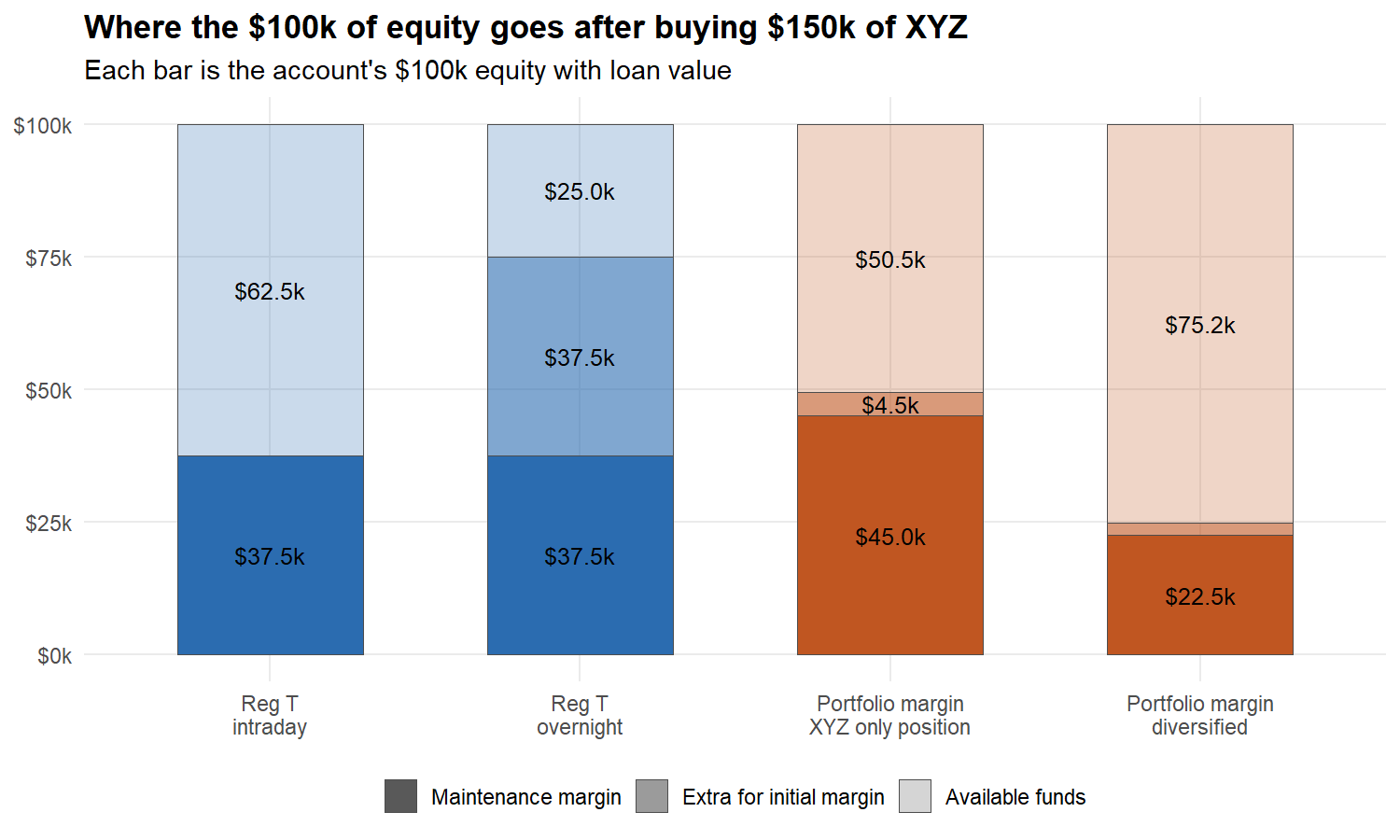
The trade fits. After it, IB would accept $250,000 more stock during the day, but only $50,000 more that you plan to hold overnight (SMA of $25,000 x 2, or Look Ahead Available Funds of $25,000 at 50%).
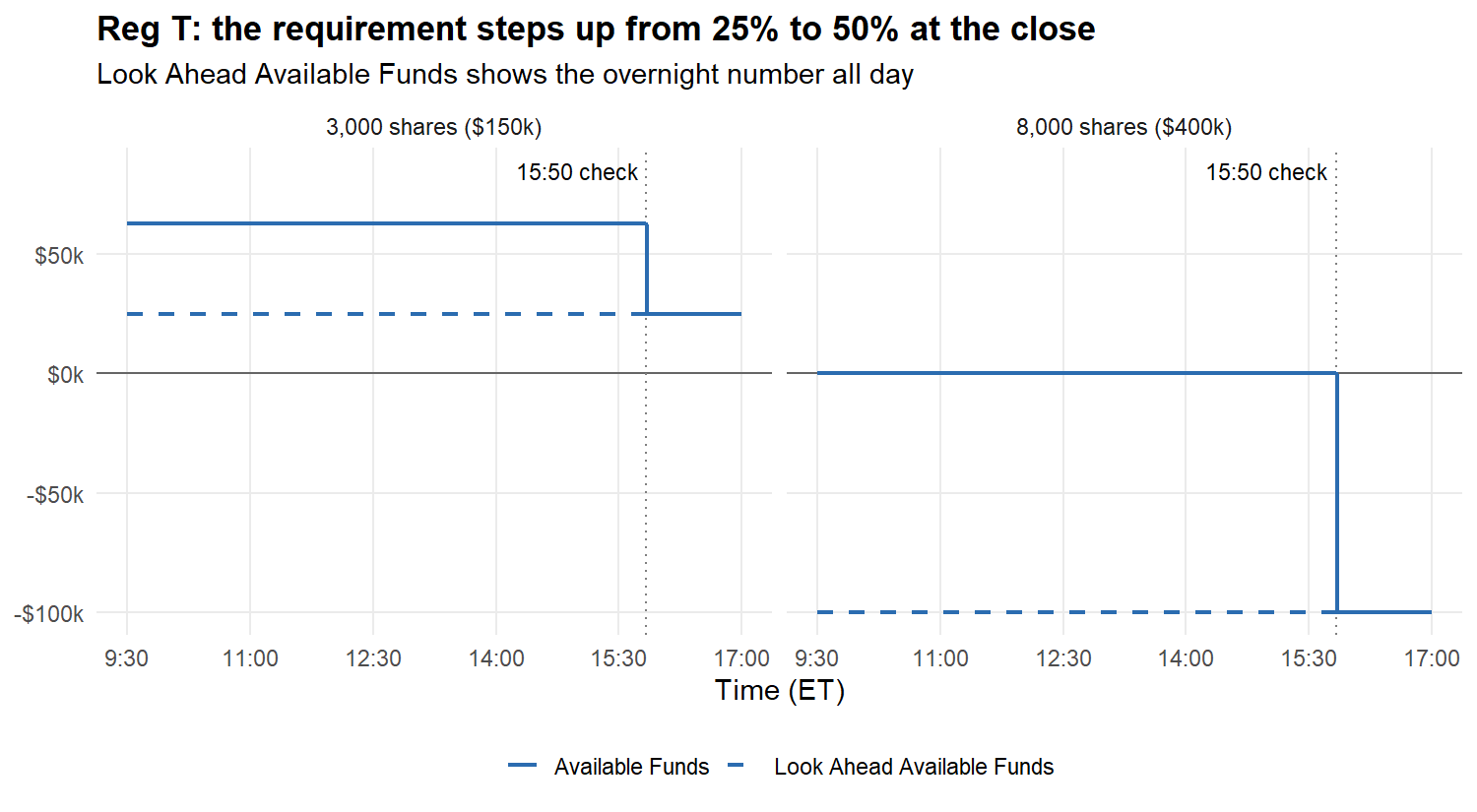
The overnight step
Here is the same account through the day, with the 3,000-share trade and with a much bigger 8,000-share ($400,000) trade. The bigger trade uses all of the account's intraday room, so IB accepts it. But at 50% it needs $200,000 overnight, and the account has $100,000. Look Ahead Available Funds shows -$100,000 from the moment of the trade. At 15:50 the SMA is negative and IB sells.
As XYZ falls
Net liquidation is 3,000 x price - $50,000, and maintenance is 25% of the position.
| XYZ price | Net Liquidation Value | Maintenance Margin | Excess Liquidity |
|---|---|---|---|
| $50.00 | $100,000 | $37,500 | $62,500 |
| $40.00 | $70,000 | $30,000 | $40,000 |
| $33.33 | $50,000 | $25,000 | $25,000 |
| $30.00 | $40,000 | $22,500 | $17,500 |
| $25.00 | $25,000 | $18,750 | $6,250 |
| $22.22 | $16,667 | $16,667 | $0 |
- Below $33.33, Look Ahead Available Funds is negative (
net liquidation - 50% of the position), so IB rejects new orders that add margin. Nothing is sold yet. - At $22.22, Excess Liquidity reaches zero and IB starts selling XYZ. That is where
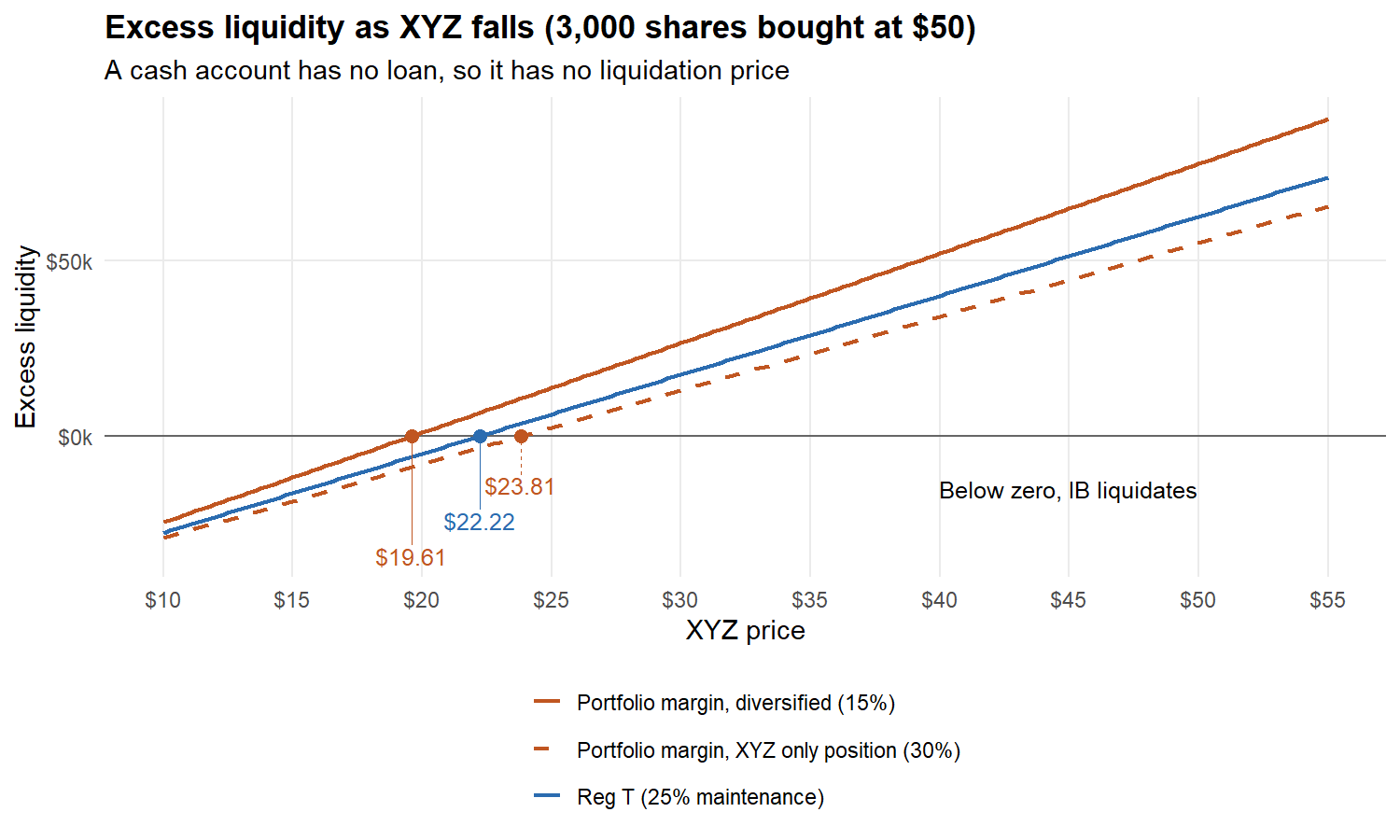
3,000 x P - 50,000 = 0.25 x 3,000 x P, soP = 50,000 / 2,250 = $22.22.
A 56% drop wipes out 83% of the account before IB steps in.
Scenario 2: Portfolio margin account
Portfolio margin sets the requirement from risk instead of a fixed percentage. IB's system moves each position's price up and down, and the requirement is the worst loss it finds. For a stock in a diversified account, the standard test is a 15% move.
Who can have one: IB requires $110,000 of net liquidation value to switch an account to portfolio margin, and $100,000 to keep trading on margin in it. A $100,000 account would not qualify. To keep the scenarios comparable, the tables below still start from $100,000, so read them as an account that just meets the minimum. In practice, any loss on XYZ would take it below the $100,000 line, and IB would stop it adding margin positions.
Initial and maintenance: for US stocks, IB sets portfolio margin initial margin at 110% of maintenance.
Concentration: XYZ is the only position in this account. IB adds a concentration charge when an account holds only a few positions, stressing the largest ones with a 30% move. A one-stock account is the most concentrated there is, so XYZ is margined at 30%, not 15%. That is more than Reg T's 25% maintenance. Portfolio margin helps a diversified account and can hurt a concentrated one.
Buying 3,000 XYZ at $50
| Value | Before | After, XYZ the only position (30%) | After, diversified account (15%) |
|---|---|---|---|
| Gross Position Value | $0 | $150,000 | $150,000 |
| Net Liquidation Value | $100,000 | $100,000 | $100,000 |
| Maintenance Margin | $0 | $45,000 | $22,500 |
| Initial Margin | $0 | $49,500 | $24,750 |
| Available Funds | $100,000 | $50,500 | $75,250 |
| Excess Liquidity | $100,000 | $55,000 | $77,500 |
| Cushion | 100% | 55% | 77.5% |
Overnight, the values stay the same: there is no Reg T step at the close. Look Ahead values change only if IB changes the stock's requirement, for example after a jump in its volatility.
The same 30% is what a volatile stock gets even in a diversified account. A stock that tends to move 30% in a day is stressed for that kind of move.
As XYZ falls
With XYZ as the only position (30%):
| XYZ price | Net Liquidation Value | Maintenance Margin | Excess Liquidity |
|---|---|---|---|
| $50.00 | $100,000 | $45,000 | $55,000 |
| $40.00 | $70,000 | $36,000 | $34,000 |
| $30.00 | $40,000 | $27,000 | $13,000 |
| $25.00 | $25,000 | $22,500 | $2,500 |
| $23.81 | $21,429 | $21,429 | $0 |
- XYZ the only position:
3,000 x P - 50,000 = 0.30 x 3,000 x P, so liquidation starts at $23.81, earlier than Reg T. - XYZ in a diversified account:
3,000 x P - 50,000 = 0.15 x 3,000 x P, so liquidation starts at $19.61.
Scenario 3: Cash account
A cash account can't borrow. You can only buy with the cash you have.
Trying to buy 3,000 XYZ at $50
The order needs $150,000 and the account has $100,000. IB rejects it. The most you can buy is 2,000 shares ($100,000).
| Value | Before | After buying 2,000 shares |
|---|---|---|
| Cash | $100,000 | $0 |
| Settled cash | $100,000 | $0 |
| Gross Position Value | $0 | $100,000 |
| Net Liquidation Value | $100,000 | $100,000 |
| Leverage | 0 | 1.0 |
| Buying Power | $100,000 | $0 |
Nothing changes overnight. With no loan there is no margin requirement, no maintenance call and no liquidation price. If XYZ falls to $25, the account is worth $50,000. If XYZ goes to zero, you lose the $100,000, and nothing more.
What limits a cash account
- No shorting. Selling short needs borrowed shares, and a cash account can't borrow.
- Settled cash. Sell XYZ on Monday and the proceeds settle on Tuesday. You can use them to buy another stock on Monday, but if you sell that stock before Tuesday, you have sold something you haven't paid for with settled money. Most brokers call this a good faith violation.
- IB's version. IB treats closing a position before settlement as a free riding violation and restricts the account to Cash Up Front for 90 days, meaning every purchase must be paid for with settled cash.
- Day trading. You can trade in and out as often as your settled cash allows. The new intraday margin rules apply to margin accounts, not cash accounts.
Why the margin rate differs from stock to stock
The 25% and 50% above are the rates for a typical long stock. IB charges more when a position is riskier for it to lend against:
- Volatile stocks can move further before IB can sell, so they need more cushion. IB raises requirements on its own servers based on its own risk measures, sometimes during the day.
- Small companies. For stocks with a market value of $500 million or less, IB runs an extra test that assumes the price could fall to zero. If that loss is bigger than the normal requirement, it is used instead.
- Concentrated positions. When one or a few stocks dominate the account, IB stresses them harder, as in the portfolio margin scenario.
- Short positions have their own, higher requirements.
The rate can also change while you hold the position. That is one reason Look Ahead values are worth watching.
IB vs DAS
With DAS, the buying power a position uses is predictable. With IB, it depends on the stock and the day.
DAS. Your broker loads your day trading buying power (Init BP) each morning, using a leverage multiple it sets for your account, such as 4x your equity. Each position then holds back buying power in proportion to its value (shown as Withhold BP in the Positions window), and BP goes down as you send orders and open positions. A $100,000 account at 4x starts with $400,000 of BP, and the $150,000 XYZ trade leaves $250,000, on any stock and any day.
The exceptions are stocks your broker lists separately. The DAS manual notes that stocks marked HiRisk carry a 50% maintenance requirement, and brokers can apply their own list of per-symbol rates. The Account window also shows OverNight BP and ONBP (overnight buying power left). DAS doesn't stop you from going over it, but your broker may call for margin or close positions.
IB. IB has no fixed multiple. It works out each stock's requirement on its own servers, from its rates for that stock, its volatility and size tests, and how concentrated your account is. So the same $150,000 trade can use $37,500 of margin on one stock and much more on another, or more today than yesterday. IB's Buying Power figure assumes a typical stock, so it overstates what you can buy in volatile names.
DAS connected to IB. If you trade through DAS on an IB account, DAS shows its own BP, but IB still applies its own requirements and can reject an order or liquidate based on them.
How the Trade Client helps. Before it sends an IBKR entry, the Trade Client asks TWS how much margin the order would use. The answer is logged and shown in the IBKR Margin Impact column on the Setups tab: the change in Initial Margin the order would cause. Compare it with Available Funds: if the impact is bigger, IB will reject the order.
Common surprises
- "Your Available Funds are insufficient." The order would push Available Funds below zero. The usual causes are a stock with a higher rate than you expected, other open orders already counted, or Look Ahead values near the close.
- Liquidated without a margin call. IB doesn't call. When Excess Liquidity goes below zero, it sells at market, and it picks which positions to sell.
- A closing order doesn't help until it fills. A sell order, including a market-on-close or limit-on-close exit, doesn't lower your requirement while it waits. If the overnight step pushes Look Ahead Excess Liquidity below zero before the close, IB can liquidate before your exit fills.
- The requirement steps up near the close. In a Reg T account, positions held into the close need 50% instead of 25%. Watch Look Ahead Available Funds, which shows the overnight number all day.
- A sale in a cash account isn't cash yet. Proceeds settle the next business day. Selling a stock bought with unsettled money before then is a violation, and at IB it means 90 days of Cash Up Front.
Sources
Checked in November 2026. Brokers change their rules, so check your broker's current pages before relying on a number.
- FINRA, Regulatory Notice 26-10: Intraday Margin Standards: replaces the pattern day trader rules; effective June 4, 2026, phase-in to October 20, 2027; portfolio margin intraday requirements.
- IB, Available for Trading values (TWS): formulas for Available Funds, Excess Liquidity, Look Ahead values, Buying Power and Leverage.
- IB, Pattern day trader reset: $25,000 minimum removed, $2,000 minimum kept, Intraday Margin Deficits, 4 failures in 12 months, transition period.
- IB, Margin requirements for US stocks: 25% real-time initial and maintenance, 50% overnight Reg T initial for long stock.
- IB, Why was I liquidated? and What is SMA?: real-time liquidation when Excess Liquidity is negative; the SMA check between 15:50 and 17:20 ET.
- IB, Portfolio margin and Risk based margin considerations: $110,000 to open, $100,000 to keep trading on margin; concentration charge of a 30% move on the largest positions; initial margin at 110% of maintenance for US securities.
- IB, Concentrated positions in low cap stocks: the $500 million market cap test.
- IB, Free riding rule: closing a position before settlement in a cash account; 90 days of Cash Up Front.
- CapTrader, Portfolio margin account: the +/-15% stress range for stocks under portfolio margin.
- SEC rule shortening settlement to T+1, compliance date May 28, 2024 (summary by Davis Polk).
- DAS Trader, user manual (Account and Positions windows, HiRisk) and Risk Control (Day BP and Night BP leverage set by the broker's risk admin).